Factor the expression by grouping. First, the expression needs to be rewritten as $4y^{2}+ay+by+1$. To find $a$ and $b$, set up a system to be solved.
$$a+b=-4$$ $$ab=4\times 1=4$$
Since $ab$ is positive, $a$ and $b$ have the same sign. Since $a+b$ is negative, $a$ and $b$ are both negative. List all such integer pairs that give product $4$.
$$-1,-4$$ $$-2,-2$$
Calculate the sum for each pair.
$$-1-4=-5$$ $$-2-2=-4$$
The solution is the pair that gives sum $-4$.
$$a=-2$$ $$b=-2$$
Rewrite $4y^{2}-4y+1$ as $\left(4y^{2}-2y\right)+\left(-2y+1\right)$.
$$\left(4y^{2}-2y\right)+\left(-2y+1\right)$$
Factor out $2y$ in the first and $-1$ in the second group.
$$2y\left(2y-1\right)-\left(2y-1\right)$$
Factor out common term $2y-1$ by using distributive property.
$$\left(2y-1\right)\left(2y-1\right)$$
Rewrite as a binomial square.
$$\left(2y-1\right)^{2}$$
Steps Using Square Of Binomial
This trinomial has the form of a trinomial square, perhaps multiplied by a common factor. Trinomial squares can be factored by finding the square roots of the leading and trailing terms.
$$factor(4y^{2}-4y+1)$$
Find the greatest common factor of the coefficients.
$$gcf(4,-4,1)=1$$
Find the square root of the leading term, $4y^{2}$.
$$\sqrt{4y^{2}}=2y$$
The trinomial square is the square of the binomial that is the sum or difference of the square roots of the leading and trailing terms, with the sign determined by the sign of the middle term of the trinomial square.
$$\left(2y-1\right)^{2}$$
Steps Using the Quadratic Formula
Quadratic polynomial can be factored using the transformation $ax^{2}+bx+c=a\left(x-x_{1}\right)\left(x-x_{2}\right)$, where $x_{1}$ and $x_{2}$ are the solutions of the quadratic equation $ax^{2}+bx+c=0$.
$$4y^{2}-4y+1=0$$
All equations of the form $ax^{2}+bx+c=0$ can be solved using the quadratic formula: $\frac{-b±\sqrt{b^{2}-4ac}}{2a}$. The quadratic formula gives two solutions, one when $±$ is addition and one when it is subtraction.
Factor the original expression using $ax^{2}+bx+c=a\left(x-x_{1}\right)\left(x-x_{2}\right)$. Substitute $\frac{1}{2}$ for $x_{1}$ and $\frac{1}{2}$ for $x_{2}$.
Multiply $\frac{2y-1}{2}$ times $\frac{2y-1}{2}$ by multiplying numerator times numerator and denominator times denominator. Then reduce the fraction to lowest terms if possible.
Quadratic equations such as this one can be solved by a new direct factoring method that does not require guess work. To use the direct factoring method, the equation must be in the form $x^2+Bx+C=0$.This is achieved by dividing both sides of the equation by $4$
$$x ^ 2 -1x +\frac{1}{4} = 0$$
Let $r$ and $s$ be the factors for the quadratic equation such that $x^2+Bx+C=(x−r)(x−s)$ where sum of factors $(r+s)=−B$ and the product of factors $rs = C$
$$r + s = 1 $$ $$ rs = \frac{1}{4}$$
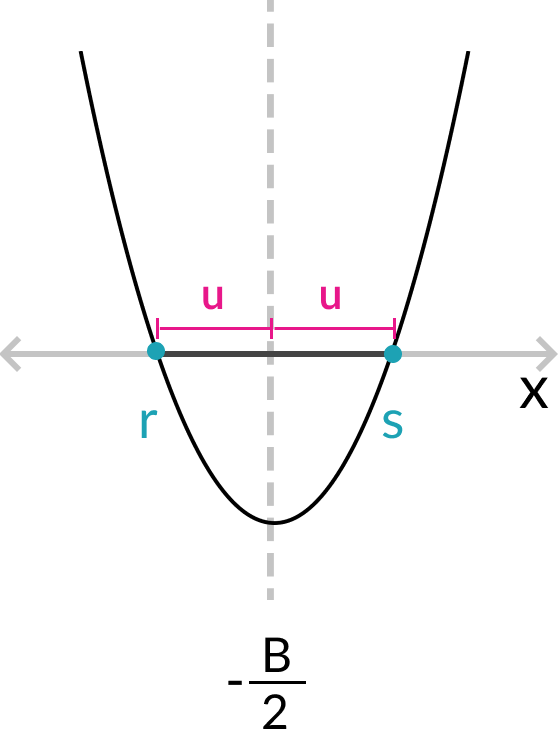
Two numbers $r$ and $s$ sum up to $1$ exactly when the average of the two numbers is $\frac{1}{2}*1 = \frac{1}{2}$. You can also see that the midpoint of $r$ and $s$ corresponds to the axis of symmetry of the parabola represented by the quadratic equation $y=x^2+Bx+C$. The values of $r$ and $s$ are equidistant from the center by an unknown quantity $u$. Express $r$ and $s$ with respect to variable $u$.
$$r = \frac{1}{2} - u$$ $$s = \frac{1}{2} + u$$
To solve for unknown quantity $u$, substitute these in the product equation $rs = \frac{1}{4}$