Quadratic polynomial can be factored using the transformation $ax^{2}+bx+c=a\left(x-x_{1}\right)\left(x-x_{2}\right)$, where $x_{1}$ and $x_{2}$ are the solutions of the quadratic equation $ax^{2}+bx+c=0$.
$$-2x^{2}+5x+1=0$$
All equations of the form $ax^{2}+bx+c=0$ can be solved using the quadratic formula: $\frac{-b±\sqrt{b^{2}-4ac}}{2a}$. The quadratic formula gives two solutions, one when $±$ is addition and one when it is subtraction.
Now solve the equation $x=\frac{-5±\sqrt{33}}{-4}$ when $±$ is plus. Add $-5$ to $\sqrt{33}$.
$$x=\frac{\sqrt{33}-5}{-4}$$
Divide $-5+\sqrt{33}$ by $-4$.
$$x=\frac{5-\sqrt{33}}{4}$$
Now solve the equation $x=\frac{-5±\sqrt{33}}{-4}$ when $±$ is minus. Subtract $\sqrt{33}$ from $-5$.
$$x=\frac{-\sqrt{33}-5}{-4}$$
Divide $-5-\sqrt{33}$ by $-4$.
$$x=\frac{\sqrt{33}+5}{4}$$
Factor the original expression using $ax^{2}+bx+c=a\left(x-x_{1}\right)\left(x-x_{2}\right)$. Substitute $\frac{5-\sqrt{33}}{4}$ for $x_{1}$ and $\frac{5+\sqrt{33}}{4}$ for $x_{2}$.
Quadratic equations such as this one can be solved by a new direct factoring method that does not require guess work. To use the direct factoring method, the equation must be in the form $x^2+Bx+C=0$.
$$x ^ 2 -\frac{5}{2}x -\frac{1}{2} = 0$$
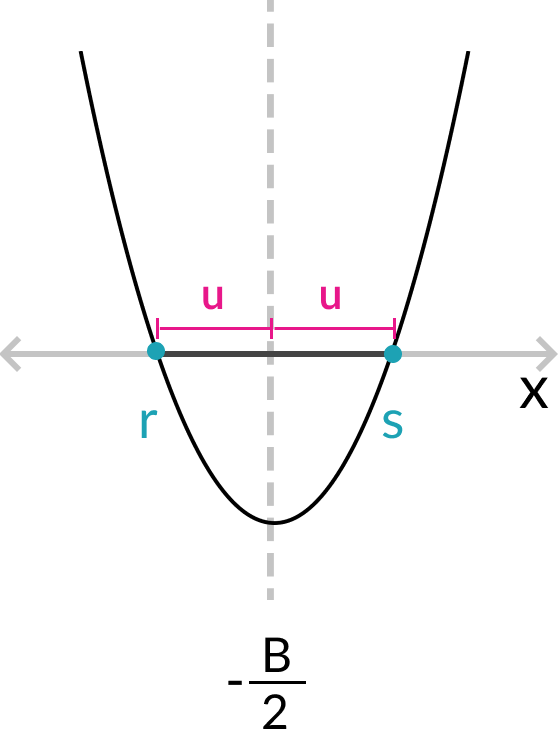
Let $r$ and $s$ be the factors for the quadratic equation such that $x^2+Bx+C=(x−r)(x−s)$ where sum of factors $(r+s)=−B$ and the product of factors $rs = C$
$$r + s = \frac{5}{2} $$ $$ rs = -\frac{1}{2}$$
Two numbers $r$ and $s$ sum up to $\frac{5}{2}$ exactly when the average of the two numbers is $\frac{1}{2}*\frac{5}{2} = \frac{5}{4}$. You can also see that the midpoint of $r$ and $s$ corresponds to the axis of symmetry of the parabola represented by the quadratic equation $y=x^2+Bx+C$. The values of $r$ and $s$ are equidistant from the center by an unknown quantity $u$. Express $r$ and $s$ with respect to variable $u$.
$$r = \frac{5}{4} - u$$ $$s = \frac{5}{4} + u$$
To solve for unknown quantity $u$, substitute these in the product equation $rs = -\frac{1}{2}$