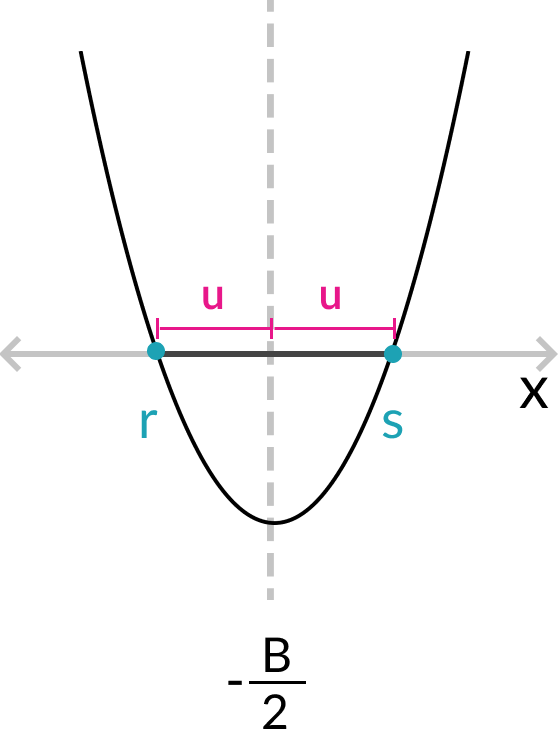
Quadratic equations such as this one can be solved by a new direct factoring method that does not require guess work. To use the direct factoring method, the equation must be in the form $x^2+Bx+C=0$.
$$x ^ 2 +8x +24 = 0$$
Let $r$ and $s$ be the factors for the quadratic equation such that $x^2+Bx+C=(x−r)(x−s)$ where sum of factors $(r+s)=−B$ and the product of factors $rs = C$
$$r + s = -8 $$ $$ rs = 24$$
Two numbers $r$ and $s$ sum up to $-8$ exactly when the average of the two numbers is $\frac{1}{2}*-8 = -4$. You can also see that the midpoint of $r$ and $s$ corresponds to the axis of symmetry of the parabola represented by the quadratic equation $y=x^2+Bx+C$. The values of $r$ and $s$ are equidistant from the center by an unknown quantity $u$. Express $r$ and $s$ with respect to variable $u$.
$$r = -4 - u$$ $$s = -4 + u$$
To solve for unknown quantity $u$, substitute these in the product equation $rs = 24$
$$(-4 - u) (-4 + u) = 24$$
Simplify by expanding $(a -b) (a + b) = a^2 – b^2$
$$16 - u^2 = 24$$
Simplify the expression by subtracting $16$ on both sides
$$-u^2 = 24-16 = 8$$
Simplify the expression by multiplying $-1$ on both sides and take the square root to obtain the value of unknown variable $u$
The derivative of a polynomial is the sum of the derivatives of its terms. The derivative of a constant term is $0$. The derivative of $ax^{n}$ is $nax^{n-1}$.